Alex Cooper
I’m a founder and builder, creating products for complex, regulated spaces, that turn messy data into results customers care about. I work with varied and often skeptical stakeholders and users - I build tools that use AI where possible and deterministic workflows when needed.
Pathways
I co-founded Pathways and led both product and business operations as co-CEO. We took the business from an idea to an enterprise product with over $2M in contracted ARR, 75+ customers, 15+ team members, and over $10M raised.
Pathways uses AI to ingest and structure manufacturers’ data, transforming it into an environmental digital twin of a customer’s production process. Our models are 3rd party verified, allowing customers to quickly publish and update Environmental Product Declarations (EPDs) of their products.
- Seamless data ingestion: AI-enabled document ingestion and direct, ongoing integrations with a manufacturer's data infrastructure, eliminating the manual data collection.
- Real-time visibility and insights: an interactive portal showing plant, product and project emissions, with benchmarking and scenario modeling.
- Unlimited EPDs and sales assets: unlimited publication of verified EPDs, and sales materials to meet demand for verified, environmentally responsible products.
Case studies
Accelerating Time to Value for Ready Mix Concrete When Pathways entered the Ready Mix Concrete (RMC) market, we found a customer base with fewer resources and less patience for an integrated EPD platform – they just wanted EPDs ASAP.
Problem
60+% of RMC customers stopped engaging with the platform if they hadn’t finished setup within 2 weeks.
Solution
I redefined the RMC product roadmap around 1 KPI – onboard at least 80% of RMC customers within 2 weeks.
Why?
- We had never onboarded an RMC in under 2 weeks. At the time we had 10 customers in various stages of onboarding, and our first customers had taken 2-3 months to onboard.
- GTM and Product resources were regularly getting pulled into customer re-engagement, increasing CAC and cost of onboarding.
- This also put constraints on our ability to grow – we temporarily had to stop new customer outbound while our onboarding backlog grew.
Outcome
Within 6 months, 80+% of our RMC customers were consistently onboarding in under 2 weeks, while the number of customers onboarding increased from ~2/month to 2/week.
How
- Identified that we need to treat RMC as a new vertical - completely rebuilt our product roadmap for these customers
- Mapped the full customer journey, identifying redundancies, steps where customers got stuck, and where our existing tools were consistently failing
- Defined the most critical information (input materials) and the data sources most likely to have this data (mix design documentation)
- Split extraction into 3 agents running on the same document, each backed by a model we fine-tuned on customer mix design documentation:
- Identify all materials that a customer uses, map them to a database of known concrete materials
- Identify supplier and locations of all materials a customer uses, map them to a database of known material suppliers
- Exception handling workflow if supplier could not be identified or did not exist in our database
- Create unique SKUs for every mix shared, with extracted input material quantities
- Built a custom onboarding UX for RMCs that allowed a customer to complete onboarding by exclusively uploading these mix design documents and answering 5-10 other questions
Verifying the platform, not every document Pathways’ platform allows manufacturers to maintain real time Life Cycle Assessment (LCA) models (effectively environmental twins) of their products, allowing them to track and improve the carbon footprint of their products. However, verifiers expected for EPDs to be point-in-time, and were unsure how to handle a live updating LCA model.
Problem
Manual 3rd party verification processes added months to the EPD publication timelines.
Solution
I partnered with program operators to define a framework for the verification of integrated software models. This reduced average initial EPD verification timelines to under 1 month, and ongoing EPD updates to under 1 week.
Why?
- The Pathways team was spending hours project managing EPD (re-)verification for every EPD update, driving up our onboarding and customer support costs
- Demand for EPD generation outstripped verifiers’ capacity to manually verify each document
- Manufacturers gained a commercial advantage by sharing verified EPDs that showed improvements to their products’ footprints.
Outcome
Pathways’ software was the first to be verified by and integrated with multiple program operators for different material industries in both North America and around the world.
How
- Established the verifier as a unique user persona, with highly technical read requirements
- Mapped the full verification process, including outlining technical documentation and LCA model requirements
- Partnered with verifiers to define software verification process and documentation requirements.
- Researched and developed a deep understanding of ISO and EN standards, and material Program Operator rules, and LCA modeling requirements
- Identified which verification steps could be automated by proving and then locking parts of the software
- Program Operator partners include ASTM, NRMCA, SmartEPD, and EPD Australasia
- Created interpretable documentation and proved software accuracy and consistency against multiple sample LCA models
- Clearly defined and documented how Pathways software used AI (data ingestion, cleaning, and structuring) and what parts of the software were deterministic and easily interpretable (LCA modeling, documentation generation)
Other work
Edtech research
arcooper333-alt.github.io/edtech-survey
What: An assessment of the education technology landscape, written to understand the education market, what trends are driving change in that market (including and beyond AI), and what has caused technologies to fail in the past. The memo lays out what new tools need to deliver to succeed, what barriers will get in the way, and maps some of the most exciting companies operating in the landscape.
Why: I wanted to explore an unfamiliar public-sector market, so I paired desk research with conversations with teachers, state education leaders, product builders and researchers.
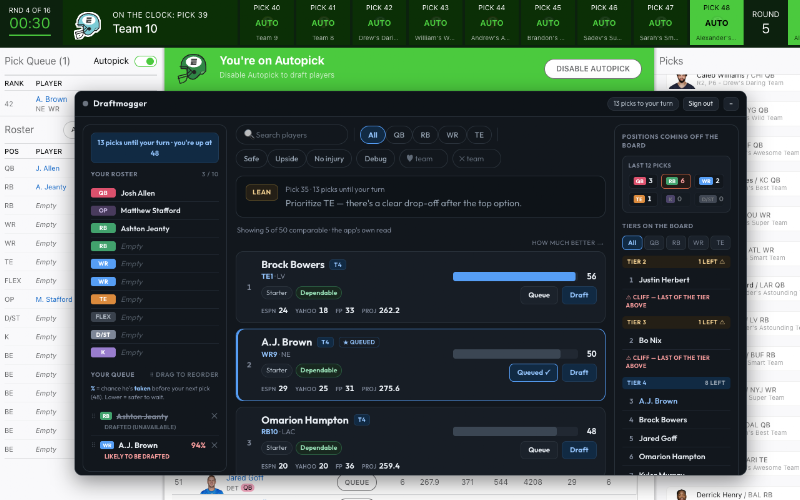
Fantasy Football Draft Co-Pilot
What: An embedded draft platform for ESPN fantasy football leagues. The hosted app scrapes and normalizes rankings and insights from expert sites into one player library, building an expert consensus of each player. The Chrome plugin sits on top of the ESPN draft room, and both reads and writes to a user’s ESPN draft. The app recommends who to pick (and why) live during a draft, based on the league’s settings, available players, and a user’s specific team needs.
Why: I built this app as a just for fun side project, to test how far I could take a hosted, multi-user product on my own with Claude Code. In particular, I focused on building a robust data pipeline, a functional and refined UX, and a multi-user experience as a published Chrome Web Store extension.